
Topics, B
B Modes > see gravitational radiation; cmb polarization.
Baby Universes
> s.a. dynamical triangulations; minisuperspace
quantum cosmology; multiverse; wormholes.
* Idea: Small
universes, spawned by the universe, usually through wormholes in a
Euclidean path integral approach to quantum gravity; They received a lot
of attentionin the late 1980s and early 1980s because of the proposed
Baum-Hawking-Coleman mechanism for suppression of the cosmological
constant; The formalism, to the extent that it is well defined, allows
for each universe to have different values for the interaction coupling
constants, and is one of the ideas that led to the development of the
concept of multiverse and the anthropic principle.
* Separate universe
problem: The claim that an overdense (positive curvature) region in
the early universe cannot extend beyond some maximum scale and remain part
of our universe.
@ General references: Dijkgraaf et al PRD(06)ht/05,
IJMPD(06) [in string theory];
Guendelman IJMPD(10)-a1003-proc;
Hwang & Yeom CQG(11)-a1106 [generation of a bubble universe];
Kawana a1405
[in the Lorentzian path integral approach];
Ansoldi et al a1801-proc [spontaneous creation, and in the lab].
@ Separate universe problem: Carr & Harada PRD(15)-a1405 [analysis].
Bach Equation > see Conformal Gravity.
Bach Tensor
> s.a. 3D gravity; huygens' principle.
$ Def: For a Lorentzian
3-manifold with metric qab,
Babc := D[a (Rb]c − \(1\over4\)R qb]c) .
* Applications: Used to study
the conformal symmetries of qab
(it vanishes iff the metric is conformally flat).
@ References: in Ashtekar & Magnon CQG(84);
Glass CQG(01)gq [and conserved current];
Álvarez et al ht/02v1 [AdS-cft].
Back-Reaction > see phenomenology of cosmological perturbations; self-force; semiclassical gravity.
Background of a Physical System
> s.a. covariance [background independence].
* Idea: A
non-dynamical structure used to define quantities of interest in a
physical theory; In Newtonian mechanics it includes \({\mathbb R}^3\) with
a Euclidean metric, and time; In general relativity it consists of a
differentiable manifold, possibly with an asymptotic metric at infinity,
but certain gravitational theories have background fields which break
diffeomorphism invariance, either spontaneously or explicitly.
@ General references: Vassallo a1602-in [conceptual analysis].
@ In gravity theories:
Bluhm a1607-conf;
Lavrov a1810.
Backward Causation > see Retrocausation.
Bäcklund Transformation
> s.a. maxwell's equations; solitons.
* Idea: In gauge
theories, a transformation of the fields that adds (or subtracts) a soliton.
@ References: Kuznetsov & Vanhaecke JGP(02)nl/00 [geometric];
Ragnisco & Zullo TMP(12) [quantum];
> s.a. integrable systems.
> Online resources:
see Wikipedia page.
Bag Model > s.a. casimir
effect; Gravitational Bag
[different kind]; QCD.
* Idea: A
phenomenological model for hadrons, originated at MIT, in which quark
confinement is simulated by enclosing them in a bag.
@ References: Chodos et al PRD(74) [baryon structure];
Colanero & Chu JPA(02) [spherical, solution];
Lavenda JPG(07)ht/06 [thermodynamic problem];
Rollmann & Miller a1501 [confining forces].
Baire Category Theorem > see distance.
Baker's Map > s.a. chaotic systems.
* Idea: A discrete chaotic system.
@ Quantum: in Schack PRA(98)qp/97 [on quantum computer];
Rubin & Salwen AP(98)qp;
Schack PRA(98) [and quantum computers];
Soklakov & Schack PRE(00)qp/99;
Inoue et al qp/01,
JMP(02)qp/01 [semiclassical];
Tracy & Scott JPA(02) [classical limit];
Łoziński et al PRE(02)qp [irreversible];
Degli Esposti et al CMP(06)mp/04 [variance and ergodicity];
Nonnenmacher & Anantharaman AHP(07)mp/05 [entropy of semiclassical measures];
Scherer et al PRD(06) [coarse-grained evolution].
> Online resources:
see MathWorld page;
Wikipedia page.
Baker-Campbell-Hausdorff Formula
> s.a. Zassenhaus Formula.
* Idea: The
solution to Z = log(eX
eY).
@ References: Van-Brunt & Visser Math(18)-a1505 [explicit formulae for some specific Lie algebras].
> Online resources:
see Wikipedia page.
Bakry-Émery Manifold / Tensor
> s.a. singularities [singularity theorems in scalar-tensor gravity].
* Idea:
A Riemannian manifold with a smooth measure.
@ General references: Lott math/02 [Bakry-Émery tensor, geometric properties];
Wei & Wylie a0706 [comparison theorems];
Limoncu MZ(12) [and applications to compactness theorems];
Zhang AGAG(14).
@ Bakry-Émery spacetimes: Woolgar CQG(13)-a1302 [in scalar-tensor theories];
Galloway & Woolgar JGP(14)-a1312 [cosmological singularities].
Ball > see sphere.
Banach Algebra
@ References: Sekhon a2104 [Gel'fand representation theorem and GKZ theorem].
Banach Space > s.a. Degree
Theory; tensors [tensor product].
$ Def: A complete
normed vector space.
* Types: A Banach space E
is reflexive iff the canonical injection E → E** is onto.
* Examples: Any
finite-dimensional or Hilbert space; Lp
for 1 < p < ∞; C([0,1], \(\mathbb R\)) with the Sup norm,
not reflexive.
* Fréchet derivative: The
differential Df of a mapping f : X → Y between
(possibly infinite-dimensional) Banach spaces, defined by f(x+h)
− f(x) = Df(x) + R(h), where
||R(h)|| = o(||h||); Example: The
operator giving the linearized version of a non-linear pde.
@ General references: Banach 32;
Cirelli 72; Lindenstrauss &
Tzafriri 77 [standard].
@ Special types: Gill & Zachary JPA(08) [construction of \(\mathbb{KS}^p\), and
\(\mathbb{KS}^2\) as Hilbert space for quantum theory];
Dow et al T&A(09) [conditions close to separability];
> s.a. Orlicz Space.
> Related topics:
see poisson brackets [on Banach manifolds].
Banach-Tarski Paradox
* Idea: A solid ball can be
taken apart into finitely many pieces that can be rearranged using rigid
motions to form a ball twice as large (or any other 3D shape).
@ References:
Tomkowicz & Wagon 16.
> Online resources: see Vsauce's
YouTube video.
Barbero-Immirzi Parameter / Connection > see under Immirzi Parameter.
Barbour-Bertotti Model > see parametrized theories.
Bargmann Algebra
* Idea: The centrally extended Galilean algebra.
@ References: Andringa et al CQG(11)-a1010,
Bennett a2104 [gauging, and Newton-Cartan gravity].
Bargmann Invariant > see phase.
Bargmann-Segal Representation / Transform > see representations of quantum theory; Segal-Bargmann Transform.
Bargmann-Wigner Formalism > see higher-spin fields.
Barker's Theory of Gravitation
@ References: Yepes & Domínguez-Tenreiro PRD(86) [cosmological models].
Barnett Effect > see magnetism.
Barometric Formula > see gas.
Barotropic Fluid > see fluids.
Barrett-Crane Model > s.a.
spin-foam models / fractals
in physics; quantum regge calculus.
* Idea: The original
* Issue: 2007,
There is a problem with the non-diagonal components of the graviton
propagator [see 070918 ILQGS by J Engle].
@ General references: Barrett & Crane JMP(98)gq/97;
Crane gq/97;
Barrett ATMP(98)m.QA [evaluation];
Reisenberger JMP(99) [vertices];
Livine gq/01 [Immirzi parameter];
Pfeiffer CQG(02)gq/01 [Euclidean, dual variables];
Baez & Christensen CQG(02)gq/01 [positivity of amplitudes],
et al CQG(02)gq [partition function];
Oriti PLB(02)gq [boundary terms];
Livine CQG(02)gq [and covariant lqg];
Lorente & Kramer gq/04-conf [and SO(4) representations];
Lorente gq/04-conf [Lorentz-invariant weight];
Maran JMP(06)gq/05 [derivation of intertwiner],
gq/05-conf [reality conditions];
Bonzom & Livine PRD(09)-a0812 [Lagrangian approach];
Kamiński & Steinhaus CQG(14)-a1310 [the measure factor].
@ Lorentzian: Livine & Oriti NPB(03)gq/02,
gq/03-proc [causality];
Pfeiffer PRD(03)gq/02;
Cherrington CQG(06)gq/05;
Cherrington & Christensen CQG(06)gq/05 [positivity].
@ And BF theory: Oriti & Williams PRD(01)gq/00 [from discretized BF theory];
Livine & Oriti PRD(02)gq/01.
@ Effects: Alexander et al gq/03 [cosmology];
Girelli & Livine PRD(04)gq/03 [Λ > 0, speed quantization];
Dupuis & Livine CQG(11)-a1102 [physical boundary states for the quantum 4-simplex].
@ Deformed: Barrett & Crane CQG(00)gq/99 [Lorentzian];
Noui & Roche CQG(03)gq/02 [and Λ > 0];
Khavkine & Christensen CQG(07)-a0704 [Riemannian, numerical, spin-spin correlation functions].
@ Variations: Pérez & Rovelli NPB(01)gq/00;
Oriti & Pfeiffer PRD(02) [+ gauge fields];
Baez et al CQG(02),
CQG(02) [numerical];
Maran gq/05 [SO(4, \(\mathbb C\)) theory];
Alexandrov PRD(08)-a0705 [from covariant lqg];
Kramer & Lorente a0804,
a0804.
Barrier Penetration in Quantum Theory > see non-linear quantum mechanics.
Barycentric Coordinates > see simplex.
Baryons > see hadrons.
Base for a Topology > s.a. topology
/ Subbase.
* Idea: A collection
of open sets generating the topology; Every other one is the union of
some subcollection of it.
> Online resources:
see Wikipedia page.
Base Space > see bundle.
Basic Physics / Science > see physics.
Basis for an R-Module > see module.
Batalin-Tyutin, Batalin-Vilkovisky, Batalin-Fradkin-Vilkovisky Quantization > see quantization of first-class constraints; quantum particles.
Batchelor's Law > see turbulence.
Bateman's Dual System > see quantum oscillator.
Bath
> s.a. Environment / spin models;
statistical-mechanical systems.
@ References: Fink & Bluhm a1402 [coupled to a single qubit, classical vs quantum bath].
Baum-Connes Conjecture > see deformation quantization.
Bayes Theory > see probability theory; for the quantum-Bayesian interpretation of quantum theory (or QBism), see probabilities in quantum theory.
BBO (Big Bang Observatory) > see space-based gravitational-wave detectors.
BCS Theory
> s.a. superconductivity.
@ References: Hainzl et al CMP(08) [for general pair interactions].
Beable
* Idea: Within
quantum mechanics, theories of "beables" are, e.g, the theories of
de Broglie, Bohm, Bell, Vink, and also "modal" theories.
@ In quantum mechanics:
Vink PRA(93);
Finkelstein PLA(96)qp/95 [measurement];
Clifton qp/97-in [algebraic];
Elze JPA(08) [symmetry of beables];
Norsen FP(10) [exclusively local beables based on pilot-wave theory];
Smolin a1507-conf [non-local];
Durham a1805 [non-local, and the concept of universe];
> s.a. hidden variables; Property [unmeasured].
@ In other theories: Anderson Sigma(14)-a1312 [and observables, in classical and quantum gravity].
Beal Conjecture > see conjectures.
Beauty of a Theory > see physical theories.
Bekenstein Bound > see entropy bound.
Bekenstein-Hod Bound > see information and physical theories.
Beliefs > see Knowledge.
Bell's Inequality / Theorem > s.a. applications and generalizations; foundations of quantum mechanics.
Bell Non-Locality > see locality in quantum theory.
Bell-Szekeres Spacetime > see gravitational wave solutions.
Benford's Law
* Idea: A statement
about the frequency of occurrence of the digits, 1, 2, ..., 9, as the
leftmost non-zero digit in numbers from many real world sources; It states
that the distribution is not uniform as one might naively expect, but
instead nature favors smaller numbers, according to a logarithmic
distribution.
@ References: Shao & Ma PhyA(10)-a1005;
Eliazar PhyA(13);
Alexopoulos & Leontsinis JAA(14)-a1401 [in astronomy];
Chanda et al EPL(16)-a1509 [and quantum correlations].
Berezinian
* Idea: The
superdeterminant of a supermetric.
@ References: Khudaverdian & Voronov mp/05 [formula].
Berezinskii-Kosterlitz-Thouless Mechanism
* Idea: A mechanism
by which certain 2D systems acquire a "quasi"-long-range order, in which
correlations fall off much more slowly than in a disordered phase.
@ References: Berezinskii JETP(72);
Kosterlitz & Thouless JPC(73);
Ries et al PRL(15)
[effect of the BKT mechanism on the superfluid phase transition of Cooper pairs].
Bergmann Manifold
@ References: Holm IJTP(90) [connections].
Bergmann-Wagoner Theory
> s.a. Birkhoff's Theorem; scalar-tensor gravity.
* Idea: A scalar-tensor theory of gravity.
@ Quantum cosmology: Pimentel & Mora gq/00 [FLRW model];
Pimentel GRG(01)gq/00 [Bianchi-I models].
Bernoulli's Equation / Principle
$ Def: The equation p
+ \(1\over2\)ρv2 + ρgy
= constant.
@ References: news uwn(09)may [simpler proof];
Faulkner & Ytreberg AJP(11)feb [understanding through simulations].
> Online resources:
see Wikipedia page.
Bernoulli Inequality > see inequalities.
Bernoulli Map / Shift
> s.a. classical systems [discrete systems].
* Bernoulli shift:
The map {xn}
→ {x'n},
with x'n
= xn+1, between
doubly infinite sequences (n ∈ \(\mathbb Z\)) of binary
numbers; As a dynamical system, it is Kolmogorov, with Kolmogorov entropy
S = ln 2.
@ References: Ordóñez & Boretz a1110-in [quantum version].
Bernoulli Numbers
$ Def: The numbers
Bn that appear
in the power series expansion
x / (ex − 1) = ∑n=0∞ Bn xn/n!
* History: First
studied by Faulhaber, but made popular by James Bernoulli.
@ References: Arakawa et al 14 [and zeta functions].
> Online resources:
see CRC page.
Bernoulli System > see ergodic theory [ergodic hierarchy].
Berry's Phase / Curvature / Connection > see geometric phase.
Berry-Hannay Model > see quantum systems.
Bertotti-Robinson Spacetime > see Robinson-Bertotti Spacetime.
Bertrand Spacetimes
* Idea: Static,
spherically symmetric solutions of Einstein's equations.
@ References: Dey et al PRD(13)-a1304 [and galactic dark matter].
Bertrand's Paradox
* Idea: Consider an
equilateral triangle inscribed in a circle, and choose a chord of the
circle at random; What is the probability that the chord is longer than a
side of the triangle? Different, apparently valid arguments give different
answers, illustrating the need for specifying the meaning of "at random".
@ References: Di Porto et al EJP(11) [physical way out];
Aerts & Sassoli de Bianchi JMP(14)-a1403 [the easy and hard parts, and how to solve them];
> s.a. Wikipedia page.
Bertrand's Theorem
> s.a. classical systems.
* Idea: The only
central potentials leading to closed orbits (for a range of initial
conditions) are the harmonic oscillator and the 1/r (Newtonian,
or Coulomb) potential.
@ References: Bertrand CR(1873)
[translation Santos et al LAJPE(11)-a0704];
Brown AJP(78)sep;
in Goldstein 80;
Tikochinsky AJP(88)dec;
Gurappa et al MPLA(00)qp/99 [quantum analog];
Zarmi AJP(02)apr
[using Poincaré-Lindstedt perturbation method];
Ballesteros et al CMP(09)-a0810 [generalization to curved spaces, and new superintegrable systems];
Santos et al PRE(09) [alternative proof using apsidal angles];
Chin AJP(15)apr [truly elementary proof].
> Online resources:
see ScienceWorld page;
Wikipedia page.
Berwald Spaces > see finsler spaces; finsler spaces and physics [Berwald spacetimes].
BESS (Balloon-borne Experiment with Superconducting Spectrometer)
@ References: news disc(09)oct.
> Relevant websites:
NASA site.
Bessel Transforms
@ References: Oberhettinger 72.
Beta Decay
> s.a. Double-Beta Decay.
* Idea: A process
occurring inside atomic nuclei in which a neutron decays into a proton,
plus an electron (beta particle) and an antineutrino, or viceversa.
* Neutrinoless double-β
decay: A process whose detection would indicate that neutrinos are their
own antiparticles, and thus Majorana fermions; The GERDA experiment ended
in 2020 with no evidence that neutrinos are their own antiparticle.
@ Neutrinoless double-β decay:
Cirigliano et al PRL(18) [new leading contribution];
news pt(19)oct
[new limits from the GERDA collaboration at the Gran Sasso];
Agostini et al PRL(20) [GERDA final results];
> see GUTs [proton decay]; neutrinos;
neutrons; particle types [lepton number violation].
> Online resources:
see Wikipedia page.
Beta Function
> s.a. renormalization group [in quantum field theory].
$ In mathematics: The function
B(x, y):= 2 \(\int_0^\infty\)dt t2x−1 (t2 + 1)−(x+y) , with Re x > 0 and Re y > 0 .
related to the Gamma function by B(x, y) = Γ(x) Γ(y) / Γ(x+y).
Bethe Ansatz
* Idea: A method for
obtaining the energy eigenstates of the one-dimensional version of
Heisenberg's model of interacting, localized spins (a quantum
many-body system).
@ References:
Karbach & Müller cm/98 [intro];
Batchelor PT(07)jan [history];
Levkovich-Maslyuk JPA(16)-a1606-ln
[pedagogical introduction, integrable QFTs and spin chains];
Eckle 19.
@ Thermodyamic Bethe Ansatz: van Tongeren JPA(16)-a1606 [pedagogical introduction].
> Online resources:
see Wikipedia page.
Bethe Lattice (Cayley Tree)
@ References: Ostilli PhyA(12) [rev].
> Online resources:
see Wikipedia page.
Bethe-Peierls Approximation > see ising model.
Bethe-Salpeter Equation
> s.a. Salpeter Equation [same?].
* Idea: Relativistic
generalization of the Schrödinger equation, used to describe bound
states; It is very useful in applications like calculating bound-state
effects in scattering and decay amplitudes in particle physics, and
understanding hadrons as quark bound states in QCD.
@ References:
Nakanishi ed-PTPS(88)#95;
Karmanov & Carbonell EPJA(06)ht/05 [solution method];
Salpeter a0811-en [origins].
Betti Numbers > s.a. euler classes.
* Idea: Topological invariants
representing roughly the number of independent p-dimensional boundaryless
surfaces which are not boundaries themselves; b0
is the number of connected components and bk
effectively counts the number of k-dimensional holes; More specifically, the number
bk is the dimension of the
k-th de Rham cohomology group.
$ Def: The k-th Betti number of
a manifold M, bk(M)
or Rk(M), is the rank of the
free part of the homology group Hk(M).
* Special cases: If there is
no torsion subgroup, bk
= dim Hk(M); If M
is closed, Bp
= B4−p,
B1 = B4 = 1;
If M is simply connected, B1
= B3 = 0.
@ References: Yano & Bochner 53;
Garvín & Lechuga T&A(03) [elliptic space, NP-hard];
Robins PRE(06)mp [for Poisson-centered spheres of given radius].
> Applications:
see matter distribution in cosmology [cosmic web].
BFCG Formulation of General Relativity > see spin-foam models.
BFV Formalism > see quantization of first-order constraints.
Bhabha Scattering
> s.a. phenomenology of non-commutative spacetime.
@ References: Bonciani & Ferroglia NPPS(06),
Becher & Melnikov JHEP(07) [2-loop QED corrections].
Bi-Differential Calculus > see symmetry.
Bi-Fundamental Fields > see types of gauge theories.
Bi-Hamiltonian Structure / System
> s.a. types of integrable systems; quantum
systems and states; symmetry.
* Idea: A
bi-Hamiltonian system is one which allows Hamiltonian formulations with
respect to two compatible Poisson brackets, i.e., Poisson brackets such
that an arbitrary linear combination of them is also a Poisson bracket;
They are related to integrable systems.
@ References: Kupershmidt PLA(87) [not necessarily integrable];
Bolsinov & Izosimov CMP(14)-a1203 [singularities];
Esen et al IJBC(16)-a1511 [3D, chaotic];
Feher a1901.
Bi-Local Fields > see types of field theories.
Bi-Spinor Fields > see types of quantum field theories.
Bialgebras > see algebra.
Bianchi Classification > s.a. bianchi I; bianchi IX; bianchi models.
Bianchi Identities > see curvature.
BICEP (Background Imaging of Cosmic Extragalactic Polarization ) > see cmb polarization.
Bicompact Space
* Idea: A compact Hausdorff
space; A bicompact space is T4.
Bicomplex
@ References: Dimakis & Müller-Hoissen IJMPB(00)ht,
JPA(00)nlin.SI [and integrable models],
JPA(01)
[and Bäcklund transformations].
Biconformal Spaces > see formulations of quantum mechanics.
Biconformal Vector Fields > see conformal structures.
Bidifferential Calculi
> s.a. symmetries.
@ References: Chavchanidze mp/01 [and non-Noether symmetries].
Bieberbach Conjecture > see conjectures.
Bieberbach Manifolds
@ References: Pfäffle JGP(00) [Dirac spectrum].
Biermann Battery
* Idea: A process
discovered by Ludwig Biermann in 1950, by which a weak seed magnetic
field can be generated from zero initial conditions.
* Applications: It is
considered a possible mechanism of formation of primordial magnetic
fields in cosmology.
@ References: Zweibel Phy(13) [and primordial magnetic fields].
> Online resources:
see Wikipedia page.
Bifurcation Theory
> s.a. Stability Theory.
* History: 1879,
Originated with Poincaré; 1933, Developed by Andronov.
* Types: Pitchfork, Hopf bifurcations.
@ General references: Iooss & Joseph 80;
Chow & Hale 82 [standard treatise];
Ruelle 89;
Gaeta PRP(90);
Crawford RMP(91).
@ Example: Johnson AJP(98)jul [unicycle].
Big Bang > see cosmology.
Big Break > see tachyons.
Big Crunch
> s.a. cosmology [future of the universe].
* Idea: A cosmological
scenario in which in the far future the universe will recollapse to
a final singularity; In the standard cosmological theory, this will
happen if the overall density of the universe is above a critical
value; Because this does not seem to be the case, the evidence
today is that the universe will not recollapse.
Big Freeze
* Idea: A cosmological
singularity that shows up in some dark energy models.
@ References: Bouhmadi-Lopez et al a1002-MG12 [avoidance in quantum geometrodynamics].
Big Rip > see cosmology.
Big Trip
* Idea: A cosmological
process thought to occur in the future by which the entire universe
would be engulfed inside a gigantic wormhole and might travel through
it along space and time.
@ References: González-Díaz PLB(06)ht [viability];
Faraoni PLB(07)gq [unfounded claims].
Bigravity > see under bimetric theory of gravity.
Bilinear Form
$ Def: A map B:
V × V → \(\mathbb R\) or \(\mathbb C\),
linear in both arguments, with V a vector space.
$ Hermitian form: A bilinear form
with B(x, y) = B(y, x)*.
* Relationships:
Any quadratic function f : V → \(\mathbb R\) determines
a bilinear form by B(u,v):= \({1\over2}\)
[f(u+v) − f(u) − f(v)].
$ Strongly non-degenerate:
A bilinear form (B: V × V → \(\mathbb R\),
considered as) B: V → V*, with V a
vector space, is (strongly) non-degenerate if it is an isomorphism (1-1 and onto).
$ Weakly non-degenerate:
B is weakly non-degenerate if it is only injective or 1-1; This
means B(X, · ) = 0 iff X = 0.
Billiard > see classical systems; causality violation [consistent evolutions]; spectral geometry / cosmological models; quantum systems.
Bilocal Fields, Bilocality > see foundations of quantum mechanics; generalized quantum field theories; non-local field theories.
Binary Objects in Astrophysics
> see black-hole binaries; star types.
Binary Operation on a Set > see set.
Binary System > see dynamics of gravitating bodies; Two-Body Problem.
Binding Energy > see matter phenomenology in gravity.
Bing Topology
> Online resources:
see Wikipedia page on R H Bing.
Binomial Coefficients
$ Def: The number of ways
to choose n different objects (unordered) out of k:
nCk
≡ \({n \choose k}\):= n! / k! (n−k)! .
* Properties: Sums,
\({n \choose m} + {n \choose m+1} = {n+1 \choose m+1}\) ;
∑k = 0n (nCk) = 2n , ∑k = 0n k (nCk) = n 2n−1 , ∑k = 0n k2 (nCk) = n (n + 1) 2n−2 , and ∑k = 0n (−1)k (nCk) = 0 .
* Remark: They get their name
from the fact that (a + b)n
= ∑k = 0n
(nCk)
an−k
bk .
@ General references: Zhang DM(06) [generalization of Calkin's identity];
Sun DM(08) [sums, and applications].
@ Generalizations: Sprugnoli DM(08) [extended to all integer values of their parameters];
Cano & Díaz a1602 [continuous analog].
Binomial Distribution
$ Def: Given that a
property occurs with probability p per trial, the probability
that it occurs exactly n times out of N trials is
Pbin(n, N, p) = \({N \choose n}\)pn (1−p)N−n .
* Cumulative binomial distribution:
The probability of it occurring j ≥ n times,
Pcb(n, N,
p) = ∑j
Pbin(j, N,
p) for j = n, ..., N.
@ Generalizations: Kowalski JMP(00);
Curado et al JSP(12)-a1105 [and Poisson-like limit];
Bergeron et al JMP(12)-a1203,
JMP(13)-a1308 [based on generating functions];
> s.a. photons [and quantum statistics].
BIon
* Idea: A finite-energy
solution of a non-linear field theory (> see, e.g., born-infeld
theory) with distributional sources (a soliton has no sources) /
Magnetic bions are stable bound states of monopoles and twisted
("Kaluza-Klein") monopoles, carrying two units of magnetic charge.
@ References: Gibbons CQG(99)ht/98 [from branes];
Tamaki & Torii PRD(00)gq [Einstein-BI-dilaton],
PRD(01)gq [string-inspired];
Anber & Poppitz JHEP(11)-a1105.
Biot-Savart Law > see magnetism.
Bipartite System > see composite quantum systems; entangled systems.
Birefringence > see polarization.
Birkhoff's (Jebsen-Birkhoff) Theorem
> s.a. spherical symmetry in general relativity.
* Idea: The only
vacuum, spherically symmetric solution of Einstein's equation is static
(and it is the Schwarzschild metric); In other words, general relativity
(and Yang-Mills theories as well) forbids monopole radiation because it
has no zero-helicity modes.
* Generalizations:
In general relativity, it can be generalized to electrovacuum solutions,
giving, as unique spherically symmetric solution, Reissner-Nordström (one
cannot, however, generalize it to axisymmetric solutions); It generalizes
to other theories, but is violated in braneworld models, such as the
Randall-Sundrum models.
@ General references: Jebsen AMAF(21),
translation GRG(05);
in Birkhoff 23; in Hawking &
Ellis 73; Bondi & Rindler GRG(97) [addendum re meaningful time coordinates];
Schmidt G&C(97)gq;
Abbassi gq/98,
gq/01 [more solutions??];
Severa gq/02 [geometry];
Johansen & Ravndal GRG(06)phy/05 [history, J T Jebsen];
Deser GRG(05) [re Jebsen];
Deser & Franklin AJP(07)mar [and t-independence in general relativity];
Zhang & Yi IJMPCS(12)-a1203-conf [and light deflection, Shapiro time delay];
Schmidt GRG(13) [different Birkhoff-type theorems].
@ With cosmological constant: Rindler PLA(98) [reformulation, Bertotti-Kasner as extra solution];
Schleich & Witt JMP(10)-a0908,
a0910 [as local result].
@ 2+1 dimensions: Ayón-Beato et al PRD(04)ht [Λ < 0];
Skákala & Visser a0903 [rotating stars].
@ Higher dimensions:
Bronnikov & Melnikov GRG(95);
Keresztes & Gergely CQG(08)-a0712 [5D].
@ In Lovelock gravity: Zegers JMP(05)gq;
Gravanis PRD(10)-a1008 [shock waves];
Ray CQG(15)-a1505 [for arbitrary base manifolds].
@ In scalar-tensor theories: Venkateswarlu & Reddy ApSS(89) [Bergmann-Wagoner theory];
Faraoni PRD(10)-a1001;
Capozziello & Sáez-Gómez AIP(12)-a1202 [perturbative approach];
Carloni & Dunsby GRG(16)-a1306
[non-minimally coupled, 1+1+2 covariant approach, and some new exact solutions].
@ In higher-derivative theories: Oliva & Ray CQG(11)-a1104 [theories in which Birkhoff's theorem holds];
Capozziello & Sáez-Gómez AdP(12)-a1107 [f(R) gravity];
Nzioki et al PRD(14)-a1312 [f(R) gravity].
@ In other theories: Brodbeck & Straumann JMP(93) [Einstein-Yang-Mills];
Schmidt G&C(97)gq [including other signatures];
Cavaglià ht/98-conf [quantum dilaton gravity];
Cavaglià G&C(99)gq [topologically massive gravity];
Deser & Franklin CQG(05)gq [with second-order field equations];
Oliva & Ray PRD(12)-a1201 [asymptotically Lifshitz black holes];
Meng & Wang EPJC(11)-a1107,
Dong et al EPJC(12)-a1205 [f(T) gravity];
Gomes CQG(14)-a1305 [shape dynamics, isotropic wormhole solution];
Mesić & Smolić a1407 [including non-vacuum cases];
Mercati GRG(16)-a1603 [shape dynamics];
Kocic et al a1708 [ghost-free bimetric theory];
Devecioğlu & Park PRD(19)-a1804 [Hořava gravity];
de la Cruz-Dombriz & Maldonado JCAP(19)-a1811 [torsion theories];
Obukhov PRD(20)-a2009 [Poincaré gauge gravity theory].
@ Consequences of non-validity: Dai et al PRD(08)-a0709 [DGP model].
@ Other generalizations:
Szenthe JGP(07);
Goswami & Ellis GRG(11) [for almost LRS-II vacuum spacetimes];
Goswami & Ellis GRG(12)-a1202 [approximately vacuum, spherically symmetric spacetimes];
Ellis & Goswami GRG(13)-a1304-proc [and local physics in an expanding universe];
Maciel et al PRD(18)-a1803 [dual null];
Weiner GRG(21)-a2103 [nsc for a spherically symmetric spacetime to be static].
Birth-and-Death Processes > see stochastic processes.
Bispectrum > see CMB anisotropy.
Bistochastic Matrix > see matrices.
Bivector
> s.a. types of field theories [bivector fields].
* Idea: An object of the form
u[a
vb],
representing the u-v plane; The magnitude can be given by
ua
vb
u[a
vb].
* In a Lorentzian metric:
The sign of the "magnitude" is related to whether the plane is
spacelike, timelike, or null.
@ References: Coley & Hervik CQG(10)-a0909 [in higher-dimensional Lorentzian manifolds].
BKL Conjecture > see types of spacetime singularities.
Black-Body Radiation > see thermal radiation.
Black Holes
> Theory: see 2D,
3D, and 4D solutions;
higher-dimensional;
in modified theories; geometry and
topology; black-hole radiation, entropy
and thermodynamics.
> Astrophysical
black holes: see binary black
holes; supermassive black
holes and other types of black holes;
black-hole uniqueness and hair.
> Phenomenology:
see black-hole formation, phenomenology
and matter near black holes; black-hole
perturbations and quasinormal modes.
> In quantum gravity:
see quantum black holes.
Black Rings, Strings > see black-hole geometry and topology.
Black Tides > see black-hole phenomenology.
Blandford-Znajek Effect > see matter and radiation near black holes.
Blazar > s.a. black-hole phenomenology;
astrophysics; gamma-ray bursts.
* Idea: Blazars are
the most common sources detected by the Fermi Gamma-ray Space Telescope;
They are black-hole-powered galaxies in which, as matter falls toward the
supermassive black hole at the center, some of it is accelerated outward
and forms jets pointed in opposite directions; When one of the jets
happens to be aimed in the direction of Earth, the galaxy appears
especially bright and is classified as a blazar
(> see NASA page).
Bloch Ball / Sphere > see discrete quantum systems.
Bloch Equations
* Idea: A set of
phenomenological equations introduced by Felix Bloch in 1946, which
describe spin precession and relaxation in external magnetic fields; They
are used in a macroscopic theory of nuclear magnetization as a function of
time (and sometimes called equations of motion of nuclear magnetization),
and are applied in nuclear magnetic resonance (NMR), magnetic resonance
imaging (MRI), and electron spin resonance (ESR).
@ References: Stöckmann & Dubbers NJP(14) [generalized to polarization tensors of various ranks in arbitrary multipole fields].
> Online resources:
see Wikipedia page.
Bloch Paradox
@ References: Schroeck JPA(09) [does not appear in quantum mechanics on phase space].
Bloch Theory
* Application:
Analyze spectral properties of differential operators which are
invariant under an abelian group.
* Bloch's theorem:
Electron wave functions in the presence of a periodic potential
(such as the electric potential of a crystalline lattice of atoms)
are of the form exp{± i kx} u(x),
where u(x) is periodic with the same period.
* Bloch oscillations:
A phenomenon that occurs when particles subject to a periodic potential
are exposed to an additional static force, say, an electric (or
gravitational) force in a single direction; The electrons then do not all
move in the direction of the force, but instead oscillate back and forth
in place; > s.a. tests of newtonian gravity.
@ General references: Gruber JMP(01)mp/00 [non-commutative generalization];
Bouda & Meziane IJTP(06)qp/07 [Hamilton-Jacobi formulation];
Cobanera et al PRB(18)-a1808 [for arbitrary boundary conditions].
@ Bloch oscillations: Lebugle et al a1501 [for 2-photon EPR states, experimental observation];
Geiger et al PRL(18) [position-space oscillations by ultracold atoms in an optical lattice].
Block Universe (or Eternalism) > see time.
Blueshift > see Redshift.
BMS Group
> s.a. asymptotic flatness at null infinity;
spin coefficients [Newman-Penrose formalism].
@ References: Kehagias & Riotto JCAP(16)-a1602 [in cosmology];
Delmastro a1708-MS [in higher dimensions];
Alessio & Esposito IJGMP(18)-a1709 [pedagogical review];
Schöller PRD(18)-a1711
[smooth, well-defined extensions into the bulk of Minkowski space];
Flanagan et al JHEP(20)-a1910 [extensions].
Bochner Theorem
* Idea: A result
on measures in constructive quantum field theory.
@ References: in Gel'fand & Vilenkin 64;
in Yamasaki 85.
Bode's Law > see Titius-Bode Law.
Bogoliubov Quasiparticle > see Quasiparticles.
Bogomolny Equation
* Idea: The equation B
= Dφ one gets in Yang-Mills-Higgs theories, minimizing the
energy with the constraint φ2
= C2, whose solution gives a
class of monopoles.
* And self-duality: If one
considers φ as the 5th component of A, the equation becomes
the self-dual equation Fab
= \(1\over2\)εabcd
Fcd, whose solutions are
static self-dual monopoles, characterized by an integer m; For
m = 1, we have the Prasad-Sommerfied solutions.
@ References: Bogomolny SJNP(76);
Coleman, Parke, Neveu & Sommerfield PRD(77).
Bogomol'ny Inequality
> s.a. positive-energy theorems.
* Idea: A lower
bound on the mass of a monopole solution in a gauge theory in terms of
its electric and magnetic charges.
@ For different theories: Lee & Sorkin CMP(88) [Kaluza-Klein monopoles];
Nozawa CQG(11)-a1011 [Einstein-Maxwell-dilaton gravity].
Bohm Metrics
* Idea: Infinite
sequences of inhomogeneous Einstein metrics on spheres and products
of spheres of dimension 5 ≤ d ≤ 9.
@ References:
Gibbons et al PRD(03).
Bohr Compactification of R
> s.a. functions [almost periodic].
* Idea: A compact
group obtained as the dual of the real line endowed with the discrete
topology; Can be used as the configuration space for a non-standard,
polymer representation for the quantum theory of a system on the real
line.
@ General references: Halvorson SHPMP(04)qp/01;
in Bratteli & Robinson 02.
@ And quantum mechanics of point particles:
Ashtekar et al CQG(03)gq/02;
Velhinho Sigma(15)-a1410 [measure-theoretic results];
> s.a Polymer Representation of Quantum Theory.
@ And quantum gravity / quantum cosmology:
Husain & Winkler PRD(04)gq/03;
Velhinho CQG(07)-a0704;
> s.a. minisuperspace.
Bohr Magneton
* Idea: The constant
μ0 = eℏ/2mc.
Bohr Model of the Atom > see history of quantum physics.
Bohr-Rosenfeld Theory > see quantum measurement [quantum field theory].
Bohr-Sommerfeld Quantization > see history of quantum physics; Old Quantum Theory.
Bohr-van Leeuwen Theorem
> s.a. casimir effect.
* Idea: A theorem
of classical statistical physics, stating that at thermal equilibrium
transverse electromagnetic fields decouple from matter in the classical
limit.
@ References: Savoie RMP-a1403 [rigorous proof in the semiclassical limit].
Boltzmann Brains
> s.a. multiverse.
* Idea: Freak
observers that pop in and out of existence as a result of rare
thermal or quantum fluctuations in the multiverse and last at
least long enough to think a few thoughts.
@ References:
Overbye NYT(08)jan;
De Simone et al PRD(10)-a0808 [and multiverse measure];
Davenport & Olum a1008;
news ns(14)may [Sean Carroll's proposal to kill them off];
Boddy et al a1505-proc
[in the Many-Worlds approach to quantum mechanics the problem is much less generic than has been assumed];
Carroll a1702-ch [why they are bad];
Tumulka a1812-MGXV [and Bohmian mechanics].
Boltzmann Constant > see constants.
Boltzmann Distribution > see ideal gas; states in statistical mechanics [canonical ensemble].
Boltzmann (Transport) Equation
> s.a. diffusion; stochastic processes.
* Idea: An equation
based on scattering theory describing non-perturbatively how the motion
of a single test particle is affected by collisions with an ideal
background gas, leading to diffusion.
* Approximations involved:
(i) Dilute gas, there are only binary collisions;
(ii) Ignore the walls of the container; (iii) Ignore the effect of
the external force on the collision cross section; (iv) Molecular
chaos, the velocity of a molecule is uncorrelated to its position.
* Chapman-Enskog method:
A successive-approximations method used to find some solutions of the
Boltzmann equation.
@ General references: in Huang 63*;
in Gorban & Karlin cm/03 [rev].
@ Derivations: Romatschke PRD(12)-a1108 [with non-ideal equation of state];
Saffirio a1602 [from many-body classical Hamiltonian dynamics].
@ Solutions and techniques:
in Huang 63 [Chapman-Enskog];
Kandrup MNRAS(98)ap/97 [collisionless, time-independent];
Cercignani JSP(05) [global, weak];
Yu JSP(06) [Green's function];
Yang & Zhao JMP(06) [energy method];
Bardos et al JSP(06) [in half space];
Arkeryd et al a0812 [Rayleigh-Bénard convective solutions];
Guéry-Odelin et al PRL(14) [non-equilibrium, with an external force].
@ And the Navier-Stokes equation:
Golse & Saint-Raymond JMPA(09)-a0808;
news Quanta(15)jul;
> s.a. fluids [Euler and Navier-Stokes equations].
@ Quantum: & Joichi, Matsumoto, Yoshimura; Singh &
Srednicki PRD(00)hp/99;
Yamamoto IJMPA(03)ap [fermions in curved spacetime];
Chen CMP(06) [as limit of random Schrödinger equation];
Breuer & Vacchini PRE(07)-a0707 [Monte Carlo simulation];
Lukkarinen & Spohn JSP(09)-a0807;
Vacchini & Hornberger PRP(09)-a0904 [rev];
Diósi PRA(09) [with finite intercollision time];
Hollands & Leiler a1003 [in quantum field theory];
Breteaux a1107 [particle interacting with a Gaussian random field];
> s.a. origin of quantum mechanics.
@ In FLRW spacetime: Takou & Noutchegueme gq/05 [spatially flat];
Lee a1307.
@ Relativistic:
Lucquiaud JMP(78);
Horwitz FP(95);
Calogero JMP(04)mp [Newtonian limit];
Noutchegueme et al GRG(05)gq,
& Dongo CQG(06)gq/05 [in Bianchi I];
Debbasch & van Leeuwen PhyA(09),
PhyA(09),
Bailleul & Debbasch CQG(12) [general-relativistic];
Lee & Rendall a1203 [Einstein-Boltzmann system];
Kremer AIP(12)-a1207 [in special and general relativity];
Drewes et al PLB(12)-a1202 [from quantum field theory, and the Kadanoff-Baym equations];
Cardall et al PRD(13) [conservative, 3+1];
Denicol et al PRL(14)-a1408,
Hatta et al PRD(15)-a1502 [solutions];
Vieira et al a2103
[first post-Newtonian (1PN) approximation].
@ Special cases, generalizations: Pulvirenti RVMP(14) [for short-range potentials];
Alexanian JMP(14) [non-Markovian];
Ampatzoglou & Pavlović a1903
[ternary, for three-particle instantaneous interactions]
@ Related topics:
Jiang et al CPDE-a0903 [acoustic limit];
Desvillettes et al KRM(11)-a1009 [Cercignani's entropy conjecture];
Trushechkin pUAA(11)-a1108 [derivation from the Liouville equation];
Brandt et al PRD(15)-a1501 [and thermal field theory, for QED].
Boltzmann Factor > see states in statistical mechanics [thermal state].
Boltzmann Principle
> s.a. entropy.
* Idea: The
relationship S = kB
ln Ω, where Ω is the number of microstates accessible to the
system in a given macrostate.
@ References: Campisi & Kobe AJP(0)jun [derivation].
Boltzmann (Maxwell-Boltzmann) Statistics
* Idea: The statistical
treatment of indistinguishable particles that is applicable when
quantum effects are negligible.
@ References: Liu et al IJTP(12) [as limit of quantum statistics].
> Online resources:
see Wikipedia page.
Boltzmann-Sinai Ergodic Hypothesis > see ergodic theory.
Bolzano-Weierstraß Theorem > see compactness.
Bondi Energy / Mass / Momentum > see asymptotic flatness at null infinity.
Bondi-Sachs Metric > see gravitational-wave solutions.
Bonnor / Bonnor-Swaminarayan Solutions
> s.a. c-metric.
* Idea:
Boost-rotation symmetric spacetimes describing pairs of
accelerating particles, possibly connected to struts.
@ References: Podolský & Griffiths GRG(01)gq/00 [null limits];
Garecki CQG(05)gq/04 [energy-momentum].
Bonnor-Ward Spacetimes
@ References: Rosa & Letelier PLA(07) [closed timelike geodesics, stability].
Boolean Algebra
> s.a. logic.
$ Def: A ring R
of subsets of a space X, with X in R.
* Result: (Sachs) A
Boolean algebra is determined by its lattice of subalgebras.
> Online resources:
see Wikipedia page.
Boost > see kinematics of special relativity.
Bootstrap Theory
* Idea: An approach to
understanding elementary particles in hadronic physics that was very
popular in the 1960s (one of the main proponents was Geoffrey Chew), as an
alternative to quantum field theory; According to this "nuclear democracy"
(G Chew) or "hadronic egalitarianism" (M Gell-Mann) view, no particles are
more fundamental than others, and they can all be seen as composites of
each other; The theory sought to derive as much information as possible
about the strong interaction from plausible assumptions about the
S-matrix, as advocated by Werner Heisenberg two decades earlier; It was
following up on these ideas that Gell-Mann eventually came up with quarks.
@ References: Chew PT(64)apr;
Redhead FP(05) [overview, assessment];
news wired(17)mar [return of the idea, space of all quantum field theories].
> Online resources:
see Wikipedia page;
description by Gell-Mann.
Bordism > the term now used for the original term Cobordism; see MathWorld page.
Borel Fixed-Point Theorem > see fixed-point theorems.
Borel Measure, Sigma-Field
> s.a. ring.
* Idea: A positive measure
on Borel sets of a locally compact Hausdorff topological space.
$ Borel sets:
The Borel σ-field of a topological space X is the
one generated by the open (or the closed) sets in X; An element
of it is a Borel set.
Borel Transform > see quantum field theory techniques.
Borexino Experiment > see neutrino oscillations.
Born Approximation > see scattering.
Born’s Reciprocity Hypothesis
* Idea: The Hamiltonian and
equations of motion for physical systems are invariant under the transformation
(p, r) → (br,
−p/b), where b is some scale factor.
@ References: Delbourgo & Lashmar FP(08) [particle in 1/r potential].
Born Rule
> s.a. interference; measurement in quantum theory;
probability in physics.
* Idea: The statement that
\(\rho({\bf r},t) = |\psi({\bf r},t)|^2\) for the probability density of
finding a particle at a location r, or more generally
that the probability of obtaining a certain eigenvalue of an observable
in a measurement is the square modulus of the corresponding coefficient
in the expansion of the state in eigenvectors of that observable.
* Remark: There have been
many attempts over the years to derive the Born rule from the wave equation,
but critics have always pointed out loopholes and unsupported assumptions;
One example is the Deutsch-Wallace decision-theoretic approach.
* Violations and tests:
Deviations from Born's law have been quantified via the Sorkin parameter, which
characterizes third-order interference and can be tested; The formalism can be
extended to many-particle interferences, which exhibits a richer structure.
@ General references:
Born ZP(26);
Squires PLA(90);
Mould qp/05 [replace by probability current alone];
Brumer & Gong PRA(06)qp [in quantum and classical mechanics];
Buniy et al PLB(06)ht [and state space discreteness];
Landsman RVMP(08)-a0804 [mathematical clarificaton of role];
Finkelstein a0907;
Cabello a1801 [explanation];
Riek a1901 [nature];
Neumaier a1902 [not universally valid];
Neumaier a1912 [and measurement, intro].
@ Derivations: Broyles PRD(82);
Zurek PRL(03),
Schlosshauer & Fine FP(05)qp/03 ["envariance"];
Jarlskog a1107 [comment on Zurek's derivation];
Brezhnev a1905;
Mandolesi a1905 [complex Pythagorean theorem];
Sutherland FPL-a2001;
Hossenfelder a2006,
comment Stacey a2103 [from almost nothing].
@ Dynamical origin: Bohm PR(53);
Valentini PLA(91) [subquantum H-theorem],
PLA(91);
Potel et al PLA(02);
Valentini & Westman PRS(05)qp/04 [in the pilot-wave interpretation, simulations];
Goldstein & Struyve JSP(07)-a0705 [uniqueness of equilibrium distribution];
Towler et al PRS(12)-a1103 [time scale for dynamical relaxation];
Bennett JPA(10)-a0908 [Lagrangian analysis];
Colin PRS(12)-a1108 [relaxation to quantum equilibrium for Dirac fermions];
't Hooft a1112;
Patel & Kumar PRA-a1509 [and gradual weak measurements];
Mayergoyz a1607
[randomness from amplification of microscopic effects];
Shrapnel et al NJP(18)-a1702 [more fundamental probability rule];
La Cour & Williamson a2004 [in quantum optics, using classical physics];
Chanda & Bhattacharyya a2104 [strongly-driven dissipative systems];
> s.a. pilot-wave interpretation.
@ Violations and tests: Kastner IJQF-a1603 [implications for the classical electromagnetic field];
news pt(17)apr [proposed test with two-slit interferometer];
Pleinert et al PRR(20)-a1810 [from many-particle interference].
@ Variations: Kazemi et al a1504 [relativistic generalization];
Galley & Masanes Quant(17)-a1610 [classification of all alternatives];
Lienert & Tumulka LMP(20)-a1706,
Lill & Tumulka a2104 [for arbitrary Cauchy surfaces];
Frauchiger & Renner a1710 [non-probabilistic substitute];
Galley & Masanes Quant(18)-a1801 [alternatives and mixed-state purification].
@ And quantum foundations:
Khrennikov PLA(08),
FP(09) [from classical random fields],
AIP(11)-a1007 [possible violation and tests];
Drezet AFLB-a1609 [in de Broglie pilot-wave theory];
Bolotin a1610 [in the intuitionistic interpretation];
Tappenden SHPMP-a1702 [in Everett's many-worlds interpretation];
> s.a. EPR experiment; experiments
on quantum mechanics; many-worlds
interpretation; sub-quantum theories.
@ And cosmology: Page JCAP(09)-a0903,
a0907,
a1003;
Cooperman JCAP(11)-a1010 [comment on Page];
Aguirre & Tegmark PRD(11)-a1008 [cosmological interpretation of quantum mechanics];
Page a1711 [generalization].
Born-Jordan Quantization
> s.a. Dequantization.
* Idea: A prescription
for promoting polynomial observables to operators in quantum theory, which
consists in using the equally weighted average of all the operator orderings;
> different from Weyl Quantization.
@ General references: de Gosson FP(14)-a1405 [for arbitrary variables, and approaches to quantization],
FP(16)-a1502 [and the angular momentum dilemma],
a1506/FP [short-time propagators].
@ Systems: Rastelli Sigma(16)-a1606 [2D anisotropic harmonic oscillator, and Weyl quantization].
Born-Oppenheimer Approximation
> s.a. semiclassical quantum gravity.
* Idea: The \(m_{\rm e}\ll M_{\rm n}\)
approximation used in the quantum theory of molecules, in which ones
divides the degrees of freedom into "heavy" ones, the nuclei, and
"light"ones, the electrons, which can be treated separately; The wave
function for a molecule can then be factorized into a nuclear part that
only depends on an electronic mean field, and an electronic part that
depends on the nucleons' positions but not their velocities.
@ References: Jecko JMP(14)-a1303 [mathematical treatment].
> Online resources:
see ChemWiki page; Wikipedia page.
Borwein Integrals
* Idea: Integrals of the
pattern-defying form (the first seven all evaluate to π/2)
@ References: Fermat's Library tweet(17); Majumdar & Trizac PRL(19) + news pt(19)aug [random walkers perspective].
Bose-Einstein Statistics > see particle statistics.
Bosons
> s.a. gas; particle statistics;
types of field theories.
* Idea: Particles
obeying Bose-Einstein statistics, such that any N-particle
quantum state remains unchanged when any two of them are interchanged;
They are usually represented in physics by boson fields, belonging to a
representation space for the Poincaré group with integer value of
the spin \(s\), and their role is that of mediators of the fundamental
interactions between matter particles.
* Composite bosons
(quasibosons): Composite particles made of two fermions can be
treated as ideal elementary bosons as long as the constituent fermions
are sufficiently entangled; Composites differ from bosons or fermions
in that their creation and annihilation operators obey non-standard
commutation relations, even for the "fermion + fermion" composites.
@ General references: Marzuoli et al JPA(14)-a1406 [su(1,1) as the natural unifying frame for characterizing boson systems];
Ray et al JPA(16)-a1512
[semiclassical initial-value representation];
Napiórkowski a2101-proc
[interacting, derivation of Gross-Pitaevskii and Bogoliubov theories].
@ Relationship with fermions: Sriramkumar GRG(03)gq/02 [interpolation];
Gough mp/03 [transformation between Fock spaces];
Pavšič ht/05 [and Clifford space];
Patton et al PhyA(05) [thermodynamic equivalence];
Nikolić FP(09) [unified description, superstrings, and Bohmian mechanics];
Marchewka & Granot a1009 [consequences of quantum statistics];
Ahluwalia a1908,
Bueno & Aguirre a2103 [spin-1/2 bosons];
> s.a. duality; Fermi-Einstein Condensation.
@ Bosonization: Liguori & Mintchev NPB(98)ht/97 [on the half-line];
Ilinskaia & Ilinski cm/98-conf;
Dhar & Mandal PRD(06)ht [non-relativistic fermions on S\(^1\)];
Kanakoglou & Daskaloyannis mp/07-conf [and parastatistics];
Sazonov a1411 [bosonization of complex actions];
Rodrigues a1611;
Benedikter RVMP(20)-a1910 [bosonic collective excitations].
@ Bosons from fermions, quasibosons:
Rajeev PRD(84);
Gavrilik et al JPA(11)-a1107 [quasiboson algebra from deformed oscillators];
Tichy et al APB(14)-a1310 [and entanglement];
> s.a. composite models.
@ Related effects: Gogolin et al PRL(08) [solution to three-body problem, including Efimov trimers];
Reslen PhD(10)-a1002 [low-temperature quantum effects];
> s.a. atomic physics; Chirality;
cosmological-constant problem; geons.
Boson Star > see astronomical objects.
BOSS (Baryon Oscillation Spectroscopic Survey)
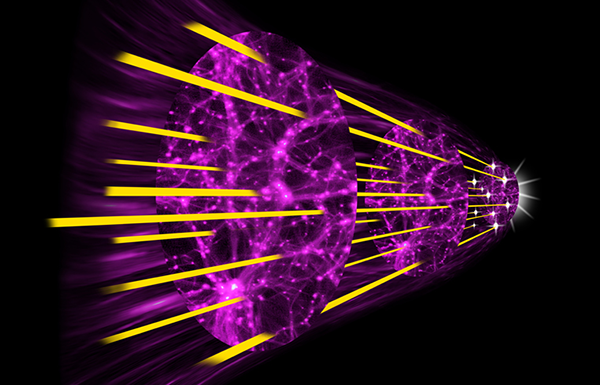
* Idea: The largest
component of the third Sloan Digital Sky Survey (SDSS-III); Redshift data
from 140,000 quasars collected by a 2.5-meter telescope at Apache Point,
New Mexico, provide the most accurate measurement to date of the expansion
rate of the Universe at different locations [@ see Phy(14)apr].
> Related topics: see
cosmological acceleration, expansion and
parameters; dark-energy
equation of state.
Bott's Periodicity Theorem
* Idea: A theorem on
periodicities in πq(G)
for Lie groups (> see homotopy).
@ References: in Milnor 73 [last chapter].
Boulware Vacuum > see quantum field theory in curved backgrounds.
Boulware-Deser Ghost
> s.a. bimetric gravity and massive
gravity [including ghost-free thories].
* Idea: A ghost in the
spectrum of certain alternative theories of gravity, such as massive
gravity and multi-gravity; Its presence is considered to make the theory
non-viable, because of the loss of unitarity of the quantum theory.
@ General references: de Rham & Tolley PRD(15)-a1505 [the vielbein formulation does not help].
@ In massive gravity: Boulware & Deser PRD(72);
Chamseddine & Mukhanov JHEP(11)-a1107,
Golovnev PLB(12)-a1112 [quadratic action];
Hassan & Rosen JHEP(12)-a1111 [secondary constraint and absence of ghost];
de Rham & Gabadadze PRD(10)-a1007;
Deser & Waldron PRL(13)-a1212 [acausality from constraint].
@ In bigravity: Hassan & Rosen JHEP(12)-a1109,
JHEP(12)-a1111 [secondary constraint and absence of ghost];
Klusoň IJMPA(13)-a1301 [no constraint to eliminate the ghost];
Yamashita et al IJMPD(14)-a1408 [with doubly-coupled matter].
Bounce
> s.a. cosmology [initial singularity].
> Classical models:
see early-universe models.
> Quantum models:
see quantum cosmology; lqc models.
Bound State > see atomic physics; states in quantum field theory; types of quantum states.
Boundary
> s.a. boundaries in field theory; spacetime boundary.
$ In homology: A q-chain
c such that c = ∂(c'), for some
(q+1)-chain c'.
$ In topology: The
boundary of a subset S ⊂ X is its closure minus
its interior, \(\dot S\) or ∂S:= closure(S)
\ interior(S).
Boundary Conditions > see boundaries in field theory; electromagnetism; quantum cosmology; statistical mechanics.
Boundary-Value Problems
> s.a. Cauchy, Dirichlet,
Neumann, Riemann-Hilbert,
Robin problem; laplace equation.
@ References: Fokas PRS(04)m.AP [linear, with variable coefficients];
Adamyan & Sushko a1306-text;
Figotin & Reyes JMP(15)-a1407
[as interacting boundary and interior systems, Lagrangian variational framework];
Krikun a1801-ln [intro].
> For specific theories:
see einstein's field equation.
Bounded Convergence Theorem
* Idea: Under
appropriate circumstances, the integral of a limit function,
is the limit of the integrals.
Bounded Operator > see operator theory.
Bounded Variation > see functions.
Bounds on Physical Quantities > see Bogomol'ny Inequality; CHSH Inequalities; Tsirelson Bound.
Box World
* Idea: A theory
(different from quantum theory and classical theory) that is sometimes
considered as reasonable because it satisfies the non-signaling condition;
It does not satisfy branch locality, however.
Boyer-Lindquist Coordinates > see kerr metric.
Boyle's Law (or Boyle-Mariotte law)
> s.a. gas [ideal-gas law].
* Idea: The volume of
a gas of fixed mass and temperature is inversely proportional to the
gas's pressure, pV = constant when T = constant.
> Online resources:
see Wikipedia page.
BPHZ Regularization Scheme > see regularization.
BPS Solutions > see black-hole solutions, and black holes in modified theories.
Bradyon
* Idea: A
slower-than-light, positive-mass particle (> as opposed
to a tachyon).
Bragg Diffraction / Scattering > see X Rays.
Braided Geometry > see geometry.
Braids / Braid Group
> s.a. phenomenology of magnetism [braided field lines];
Yang-Baxter Equation.
* Braid: A braid is a set
of n strings or "strands" stretching between two sets of n
points on parallel lines in 3D space; Or actually an equivalence class of
such sets of strings under deformations.
* More precisely: The
strands must start and end at distinct points, always move towards the
second line without "turning around", and no two strands can intersect;
Two braids with strands connecting the same pairs of points are
inequivalent if they differ by which strand passes in front of the other
when two of them cross; So, in particular, if the two lines are
represented in the z = 0 plane as x = 0 and x
= 1, then each strand i must include a function y(x)
starting at the i-th point (0,yi)
and ending at some yπ(i).
* Braid group:
Braids with n strands form the group Bπ,
where the group composition law consists in placing the braids one next to the other.
* Applications:
They have been used as tools in the calculation of knot and link
invariants; > s.a. 3D general relativity;
composite models.
@ Braid group: Cappuccio & Guadagnini PLB(90) [statistics];
Kassel & Turaev 08;
Iliev a1004 [permutation representations];
> s.a. group types.
@ Invariants: Berger LMP(01);
Nechaev & Voituriez NPB(05) [3-strand, Brownian].
@ And physics: Lomonaco & Kauffman SPIE(11)-a1105 [quantization].
> Online resources:
see John Baez page;
Wikipedia page.
Brane World > s.a. brane cosmology; brane-world gravity.
Brans-Dicke Theory > s.a. brans-dicke phenomenology.
Bravais Lattice > see crystals.
Breathers
> s.a. lattice theories [discrete breathers].
* Idea: Solutions
of (non-linear) field theories that are time-periodic and (typically
exponentially) localized in space.
Bregman Divergence > see distance [generalized].
Breit Equation > see modified formulations of QED.
Breit-Wheeler Process > see QED phenomenology.
Breit-Wigner Amplitude
@ References: de la Madrid PTPS(10)-a1005.
Bremsstrahlung > see acceleration radiation.
Brick Wall Model > see black-hole entropy.
Brieskorn Sphere > see 3-manifolds.
Brillouin Zone > see cell complex; crystals [quasicrystals].
Brillouin-Wigner Perturbation Expansion
@ References: see Ziman 69, pp 55–56.
Brinkman's Theorem > see types of spacetimes [Einstein spaces].
Bronstein Hypercube > see quantum gravity.
Brouwer Theorem
> s.a. fixed-point theorems.
$ Def: The unit
sphere Sn in En
is not a retract of the closed unit ball Bn
which it bounds.
Brown Dwarfs
> s.a. extrasolar planets.
* Idea: Substellar
objects that are not massive enough to start main sequence H burning
(their masses are between 0.001 and 0.1 \(M_\odot\)); They can be seen in the
infrared through the release of some of their internal gravitational energy.
* Consequences:
They are a candidate for dark matter (Bahcall 1984).
* Observation methods:
Look for methane lines in spectrum.
* Examples:
Jupiter; VB8B, first outside the solar system, M
~ 10–50 MJup, T
= 1360 K, R = 0.09 RSun);
Gliese 229B, first unambiguous sighting, d ~ 30 ly, M
~ 20–50 MJup, T <
1000 K [@ Nakajima et al Nat(95)nov].
@ I: Martin et al AS(97),
Basri SA(00)apr [discovery];
Mohanty & Jayawardhana SA(06)jan.
@ General references:
Jameson & Hodgkin CP(97);
Oppenheimer et al ap/98-in [rev];
Chabrier JPCM(98)ap/99-in [physics];
news ns(10)may [formation from stellar close encounters];
Baraffe in(14)-a1401;
Luhman ApJ(14)-a1404
+ news nasa(14)apr [newly discovered one 2 pc from the Sun].
> Online resources:
see Wikipedia page.
BRST Transformations / Quantization
Brudno Theorem
* Idea: A result in
classical information theory, relating entropy rate and algorithmic
complexity per symbol.
@ References: Benatti et al CMP(06) [quantum version, connecting von Neumann entropy rate
and quantum Kolmogorov complexity].
BTZ Spacetime > see 3D black holes.
Bubbles
> In ordinary matter: see Floating;
fluids; meta-materials [foam, soap bubbles];
Surface Tension.
> In cosmology:
see Baby Universes [bubble universes]; brane-world cosmology;
inflation [bubble collisions]; multiverse;
quantum phase transitions [early universe].
> Other
gravity-related: see causality violations
[warp bubbles]; kaluza-klein phenomenology.
Bubble Divergences > see topological field theory.
Bubble Networks > see spin networks.
Buchdahl Inequality > see astrophysics.
Buchdahl Metric / Solution > see types of spacetimes [cylindrically symmetric].
Buckingham's Theorem > see Dimensional Analysis.
Buffon's Needle > see statistical geometry.
Bumblebee Gravity / Mechanism
> s.a. wormhole solutions.
* Idea: A simple model for
investigating the consequences of spontaneous Lorentz violation, in this
case by tensor-valued fields acquiring vacuum expectation values; The
proposal arose in the context of string theory.
@ References: Delhom et al a1911 [metric-affine];
Carvalho et al a2103
[deflection angle of light by black holes].
Bunch-Davies Vacuum > see quantum field theory in curved backgrounds.
Bundle [including Bundle Gerbes, Bundle Map]
Buoyancy / Buoyant Force > see Floating.
Bures Metric > see mixed quantum states; riemannian geometry; types of distances.
Burgers Equation
* Idea: A
partial differential equation used in fluid dynamics.
@ References: Kirsch & Simon mp/01 [forced, approach to equilibrium];
Hamanaka & Toda JPA(03) [non-commutative];
Bec & Khanin PRP(07) [turbulence].
> Online resources:
see Wikipedia page.
Burnside Ring of a Group > see ring.
Butcher Group > related to Hopf Algebras.
Butcher Series > see scalar field theory.
Butterfly Effect > see quantum chaos.
BV Quantization > see under Batalin-Vilkovisky.
main page
– abbreviations
– journals – comments
– other sites – acknowledgements
send feedback and suggestions to bombelli at olemiss.edu – modified 24 may 2021