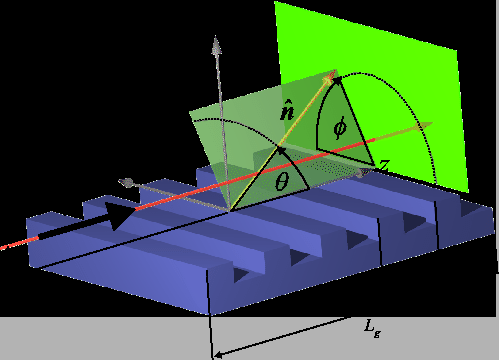
| A classical result of Maxwell electromagnetic theory states that an electric charge in uniform motion in vacuum does not radiate. However, there are two ways to have radiation from a charge moving with constant velocity. The first way is uniform motion in a medium with velocity exceeding the phase velocity of light in that medium (Cherenkov radiation). The second way is motion in inhomogeneous media, such as crossing a planar interface between two media with different refractive index (Ginzburg and Frank effect). More generally, any motion near finite-size objects induces radiation, in a process called Electromagnetic Diffraction Radiation (EMDR). One of the first experimental verifications of EMDR was provided by Smith and Purcell. Their experimental set-up consisted of an electron beam parallel to the surface of a metal diffraction grating (see figure to the right). |
|
|
Researchers at Olemiss have recently shown that spacetime inhomogeneities may induce gravitational emission through a mechanism which is the analogue of EMDR. (Read the original paper at this link.) The Smith-Purcell effect occurs when a charged particle propagates near an inhomogeneous conductor. Similarly, GDR occurs when a particle moves near an inhomogeneous object that couples gravitationally. The geometry of the object and the strength of the gravitational coupling determine the magnitude of the GDR. GDR emission in low-energy classical physics or astrophysics is generally expected to be negligible because of the weakness of gravitational interaction. However, there are theoretical models and physical systems where GDR may become relevant and could be detected. One of these models is, for example, the Randall-Sundrum braneworld scenario. |
|
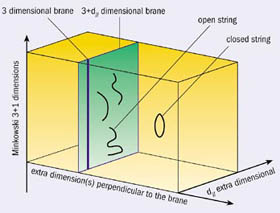
Braneworld
models have attracted a lot of interest in recent years, revolutionizing our view of how our universe
may be described. The central idea of braneworld scenarios is that the visible universe is restricted to a
four-dimensional brane inside a higher-dimensional space, called the bulk. (See figure
to the left.) The additional dimensions are taken to be compact and other branes may be
moving through the bulk. Interactions of the visible brane with the bulk and hidden branes introduce
effects not seen in standard physics.
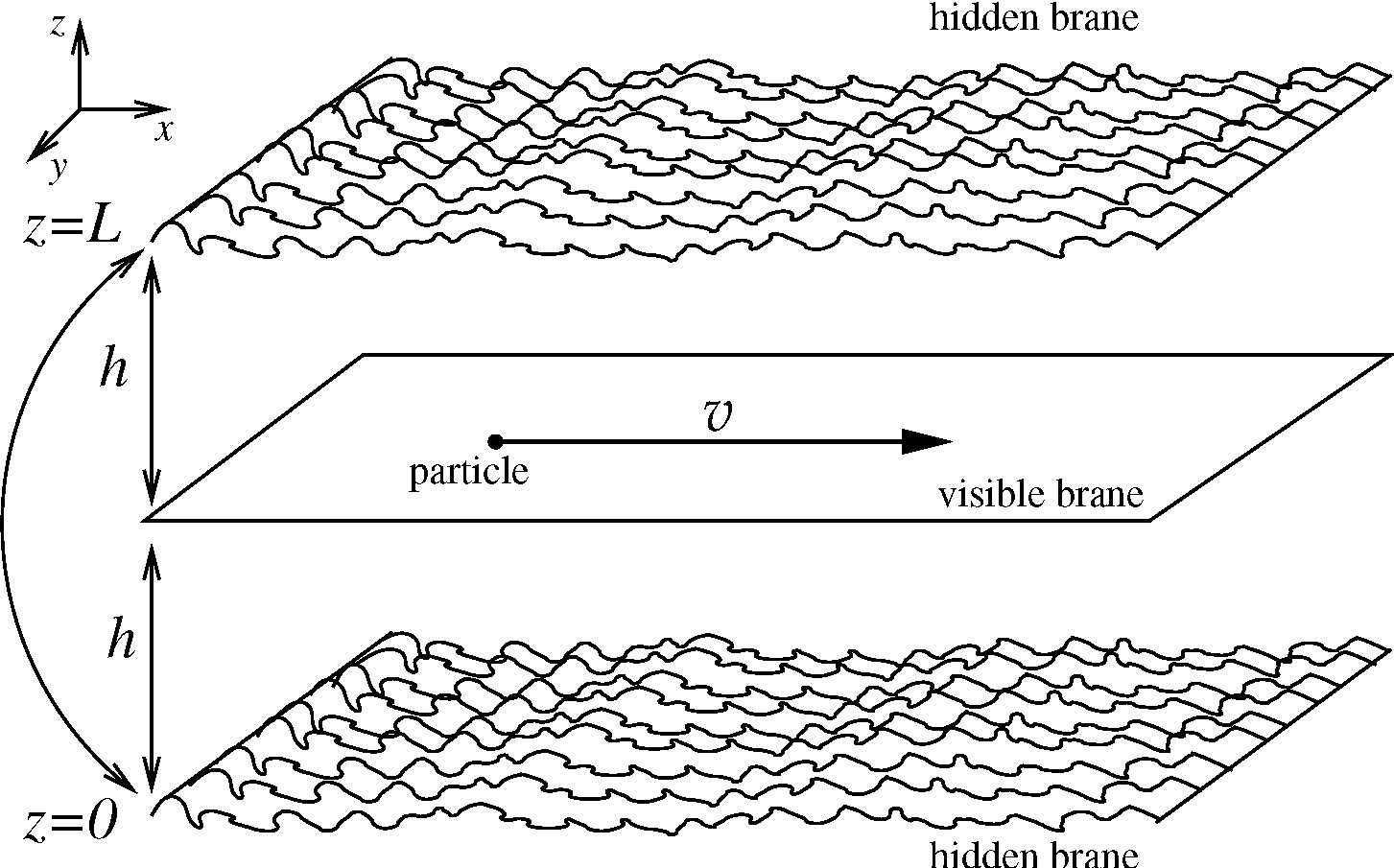
In this set-up, a particle in uniform motion on the visible brane radiates gravitational waves due to the presence of a second (hidden) brane at finite distance, which plays the role of the metal diffraction grating of the Smith-Purcell experiment. GDR on the visible brane is due to the existence of inhomogeneities on the hidden brane. The model is illustrated pictorially in the figure above. |
 |
| GDR effects may also show up in a variety of physical situations besides braneworld models. For example, GDR could play an important role in the very early universe or near the horizon of black holes. Direct signatures are unlikely to be observed in these cases. However, GDR emission could lead to interesting predictions at theoretical level and possibly indirect observable effects. |