The Sun
(Helios)
External Links page.
  

Bulk Properties

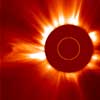
  • Appearance: A 0.5°-wide bright disk; Apparently smooth and uniform, during eclipses shows an "atmosphere", and upon closer inspection shows sunspots and other features.
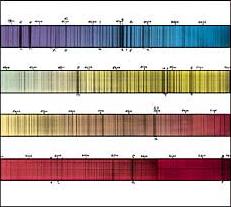
  • What is it? From its spectrum we know it is a star (a mid-sized star, the only one we can see from up close), and now we know that stars are burning balls of gas, with heat pressure and gravity keeping it in equilibrium.
  • Distance: 1 AU = 150 million km away [can be found using parallax of planets like Mars], or 8 minutes of light travel time.
  • Size: Actual radius 700,000 km = 100 Earths [ = 10 Jupiters]; [mass = 300,000 Earth masses = 1000 Jupiters; Mean density = 1.4 times that of water.]
  • Temperature, Luminosity: On the surface T = 6000 K (from spectrum), so it is partially ionized; Given the power it emits, the Sun has existed much longer than could be explained if it was a regular burning fire.
  • Rotation: Slow and differential (about 27 days at the equator, slower at the poles – it is made of gas), so the Sun is almost perfectly round.

  Exploration

  • Solar Missions: Several spacecraft are studying various aspects of the Sun [Ulysses was launched in 1990 to study the Sun's polar regions, SOHO (Solar and Heliospheric Observatory) in 1995 to monitor solar activity, HESSI in 2002 to study the causes of solar flares].
  • Solar Environment Missions: Other spacecraft are studying the corona, solar wind and magnetosphere, and the interplanetary medium [examples are Wind launched in 1994, ACE (Advanced Composition Explorer) launched in 1997, TRACE (Transitional Region and Coronal Explorer) launched in 1998].
  • Special Missions: Genesis, launched in 2001, collected solar wind samples and returned them to Earth in 2004 (although the capsule crashed).

Main Parts of the Sun

  • Core: T = 15 M degrees, totally ionized; Nuclear reactions take place here: H nuclei (protons) → He nuclei mostly by the p-p chain, with a huge release of energy.
  • Other interior: Radiation zone (ionized and transparent to radiation, energy carried outward by high energy photons) and convection zone (heat slowly carried outward by the gas, continuously absorbed and re-emitted at decreasing temperatures).
  • Photosphere: The bubbling "surface" we see from here, because most of the visible light comes from it; 91% H, 9% He, some O, C, N, ...; Granules (1000 km across, 15-20 min in duration) are evidence for convection.
  • Chromosphere: A thin [only 2000 km!], cooler and reddish layer.
  • Corona: Thick, extremely hot and ionized layer, T > 1 M degrees!
  • How do we know? From observations, theory, and computer models; one important aspect that provides a lot of information is the ringing of the Sun, its vibrations (the subject is also called helioseismology).

  Solar Activity

  • Sunspots: They look like holes even in detailed pictures, but are in reality slightly cooler places 10,000 km wide, that last for many days, where gas flows downward; Due to twisting of magnetic field lines; We can use them to see the Sun rotate.
  • Flares: Bursts of energy that happen on short time scales (minutes to hours).
  • Prominences: Huge (100,000 km, may last hours to weeks), they extend way out; Eventually may give rise to coronal mass ejections that intensify the 500 km/s solar wind made of protons, other ions, and subatomic particles, and reach some of the planets and beyond.
  • The solar activity cycle: Sunspots and associated activity have an 11-year cycle, and in 2006 we are near a minimum (for example, very few sunspots on the surface).

Solar Weather and Effect on Earth
  • General effect: Intense solar activity is potentially dangerous for power and communications (including cell phone calls – especially near a maximum!); It also has a less understood effect on climate.
  • Mechanism: Coronal mass ejections can cause magnetic storms when the charged particles reach the Earth.
  • Nicer effect: They cause auroras (Northern and Southern lights).
  • Further out: Matter ejected from the Sun reaches the edge of the Solar System.


  The Sun's Environment
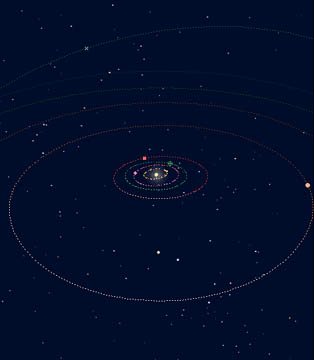
  • Major planets: A total of eight or nine of them; Four relatively "small", "closely spaced" and mostly rocky planets in the inner Solar System; Four large, widely spaced, mostly gaseous planets in the outer Solar System; One additional object, Pluto, has been called a planet for over 70 years.
  • Minor planets: Thousands of rocky asteroids between the inner and outer Solar System, from almost 1000 km across to tiny ones.
  • Beyond Neptune: A huge number of additional, more icy objects of size somewhat similar to asteroids.
  • Interstellar environment: The termination shock, and the heliopause that some of our spacecraft are starting to explore. Beyond that is the local cloud of interstellar matter, that blends into the galaxy (in which there must be many other stellar systems similar to ours...).

Up to astronomy resources; Page by Luca Bombelli <bombelli"at"olemiss.edu>, Modified 8 aug 2006