Properties
of Matter
- Different phases: Bulk matter can be
in the solid, liquid, or gas form. Sometimes the same substance
can be in any of those three phases, depending on its temperature
(and pressure); Evaporation, melting are examples of phase transitions.
- Why? To
understand, we need to make a model for what matter
is made of,
and
what
happens
when we give or take away energy.
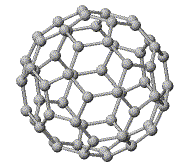
- Atoms and molecules: The smallest units
of a simple substance (an element) are atoms, those of a compound substance
are molecules, or combinations of atoms held together by chemical bonds.
- Is there a highest temperature? Probably not; A fourth phase is that of a plasma, ...
|
- Heat and energy: Heat is energy and produces
random motion. When the temperature rises, atoms or molecules move
faster, flow more easily past each other and take up more space.
Heat can travel,
by conduction, convection or radiation.
|
_232x356.jpg)

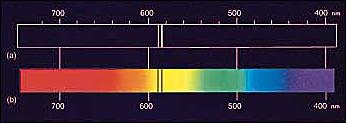 For thin gases: You get an emission
line spectrum, with wavelengths that depend
on the atoms or molecules, which can emit only certain fixed
amounts of energy.
For thin gases: You get an emission
line spectrum, with wavelengths that depend
on the atoms or molecules, which can emit only certain fixed
amounts of energy.