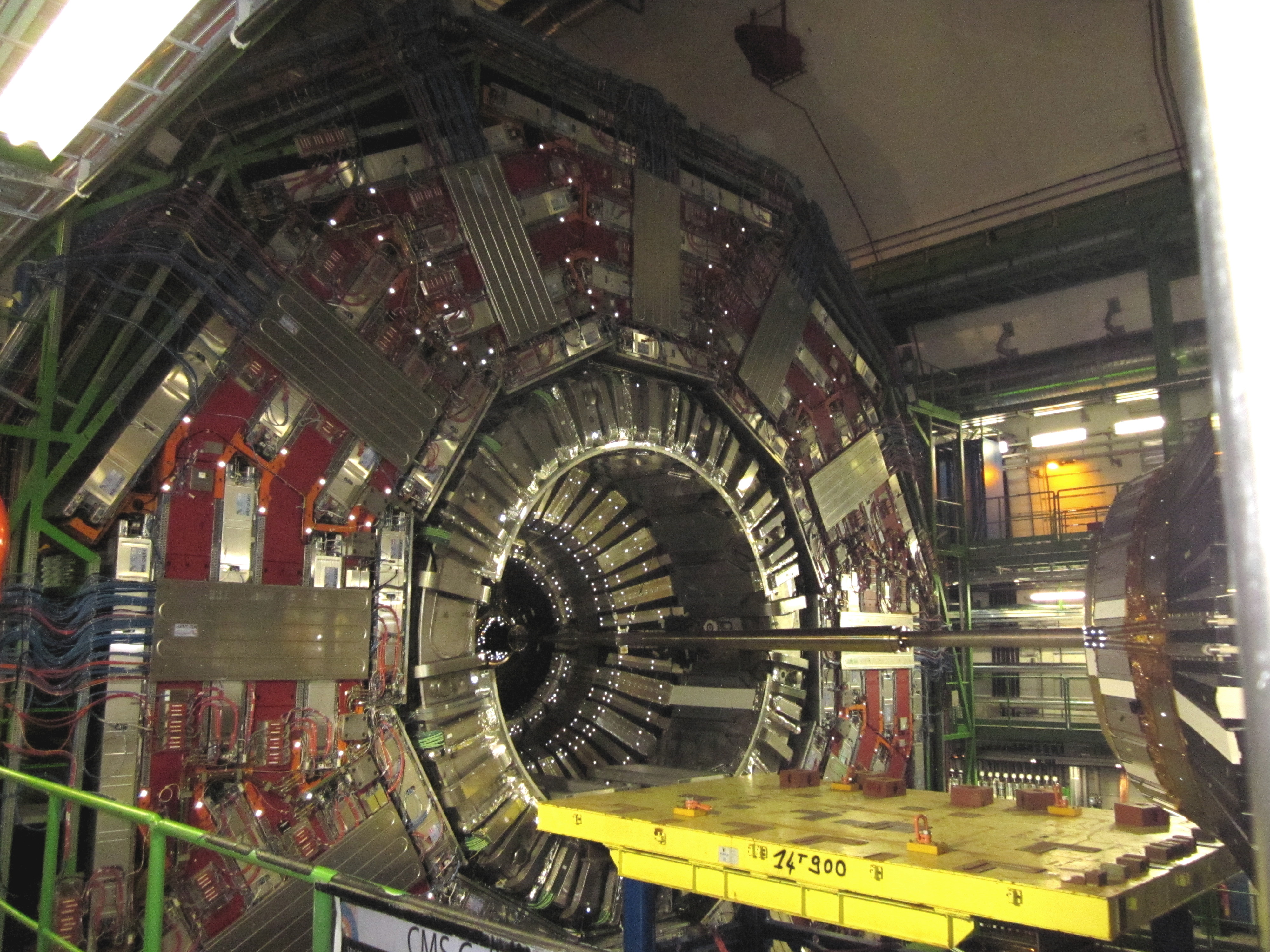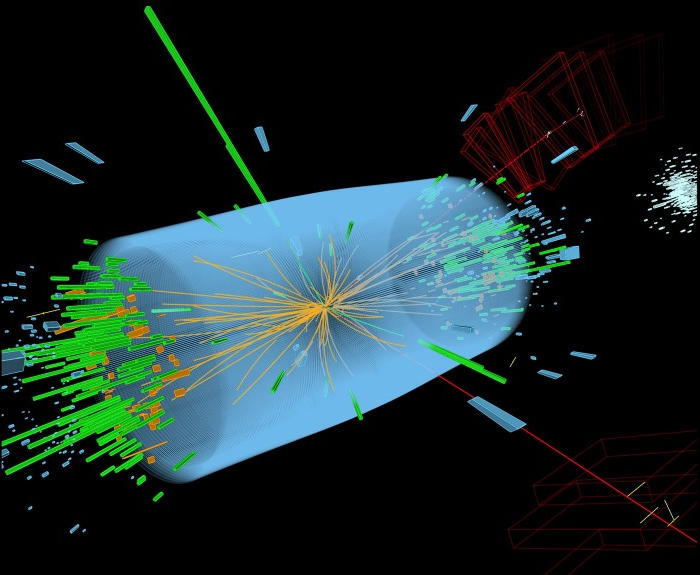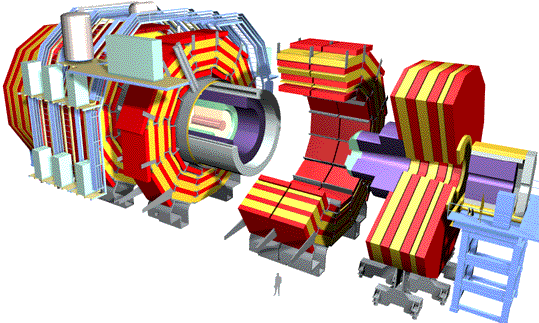
The Standard Model now explains all of particle physics phenomena to great detail below 200 GeV. But particle physicists are studying collisions in the TeV energy regime at CERN's Large Hadron Collider ( LHC) to search for violations of the model. The LHC, located at CERN near Geneva, Switzerland, iscolliding protons on protons at 13 TeV in the center of mass. The CMS detector is one of two large experiments that was constructed to investigate the the results of collisions in a search for the Higgs particle, dark matter, supersymmetric particles, and other non-Standard Model phenomena.
The LHC began running in 2009. The Higgs particle was discovered in 2012.
|
|
|
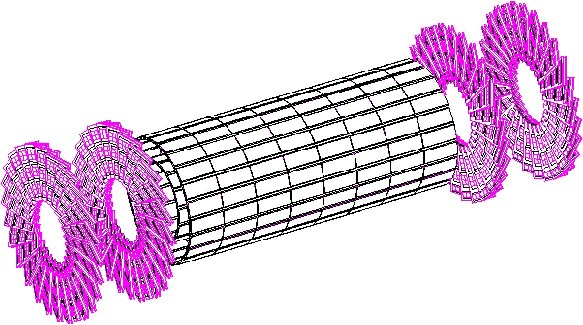
The high-energy physics group at The University of Mississippi, along with other U.S. and international groups, has participated in the design and construction of the CMS experiment. We have worked on the Hadron Calorimeter, which measures the energy released in the violent collisions, and provide a trigger for rare phenomena. We have also worked on a Pixel-tracking Detector able to determine the precise origin of particles in the interaction to 30 micrometers. This fine-grained tracking is decisive in distinguishing rare events from normal background interactions. |
|
|
An introduction to CMS is availble as well as a Brochure. Our High Energy Physics outreach is available from QuarkNet. |
|
This page has been viewed 8843 times.


Webmaster: David Sanders
Last Modified: Thursday, 15-Aug-2019 18:12:58 CDT
Copyright © 2021 The University of
Mississippi. All rights reserved.
Contact the Department of Physics and Astronomy