Groke is a Monte Carlo program to simulate black hole air showers in the atmosphere.
Thorne's hoop conjecture states that a horizon forms when a mass M is compacted into a region with circumference in every direction smaller than twice the Schwarzschild radius R(M). At subnuclear level, this can be achieved by scattering two partons on the brane with center of mass √s larger than M and impact parameter b larger than R(M).
If the gravitational coupling constant is of the order of few TeV, collisions leading to black hole or brane formation can occur in the atmosphere, via collisions of nucleons and ultra-high energy cosmic rays.
The nucleon-nucleon cross section for formation of black holes and branes is very small compared to other standard model hadronic processes. However, the neutrino-nucleon cross section for black hole and brane formation may be higher than the standard model cross section. Under the most favorable circumstances, the cross section for black hole formation at the TeV scale reaches millions of pb for neutrino-nucleon collisions in the atmosphere. Cosmic ray detectors might observe black hole formation in the atmosphere via extensive air showers originated by Hawking emission in the decay phase.
The black hole formation at parton level is usually described by a superposition of two shock waves travelling in opposite directions (Aichelburg-Sexl waves). The union of these shock waves defines a closed trapped surface that allows to set a lower bound on the black hole mass. The black hole mass depends on the impact parameter and monotonically decreases with the impact parameter from a maximum of about 60-70% of the center-of-mass energy for head-on collisions.
The partonic cross section is then convoluted with the parton distribution functions of the nucleon to obtain the total and differential cross section. The initial mass of the black hole determines the black hole decay, which is expected to happen in four distinct stages: I. radiation of excess multipole moments (balding phase); II. spin-down; III. Hawking evaporation; IV. final explosion or formation of a BH remnant.
The physics of black hole formation and decay is determined by a set of fundamental parameters and constants of nature, the most important being: the Planck scale, the number of extra dimensions, the amount of gravitational loss at formation, the minimum-allowed black hole mass, the final black hole mass and the number of hard quanta (or remnant) at the end of the decay.
Detection occurs through the standard model secondary products of black hole decay which propagate in our visible brane. The primary quanta emitted in the Hawking phase and the final decay phase are quarks, leptons, and gauge bosons. The quarks and gluons from the black hole and nucleon remnant fragment into hadrons, and together with leptons and decayed weak bosons provide the energy to initiate the air shower.
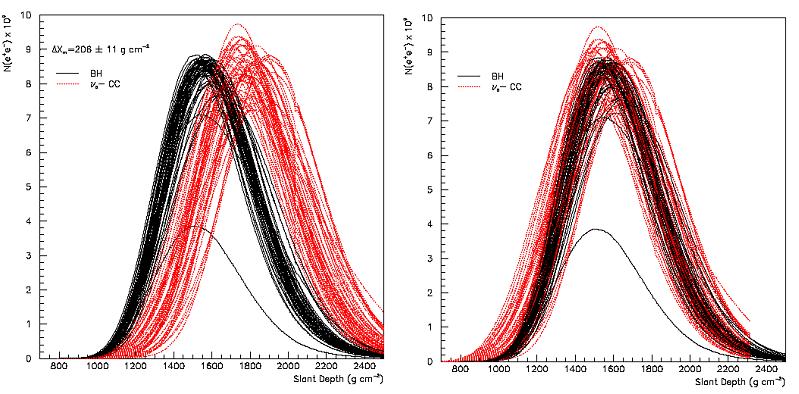
Due to the (almost) democratic nature of the decay, black hole interactions generate different air showers from standard model interactions. The black hole air showers tend to rise faster and have larger muon contents than the standard model air showers. A black hole air shower is similar to a hadronic air shower occurring at a much greater depth in the atmosphere, i.e., a very deeply penetrating hadronic air shower. However, poor statistics and inability of realistic detectors to observe the first interaction point hide most of the differences between black hole and standard model air showers.
The figure above shows the simulations of the longitudinal development of air showers with primary neutrino energy 107 TeV (number of e+e- pairs versus slant depth). The ν-charge current (CC) air showers are shown in red and black hole air showers in black (obtained with Groke 2.0). The simulation is for a ten-dimensional spacetime with fundamental Planck scale equal to 1 TeV, minimum black hole mass equal to 2 TeV, and no gravitational loss at formation. The left panel has both air showers with identical fixed first interaction points. The right panel shows a shift in the first interaction point such that the maxima of the showers coincide. The difference between the black hole and standard model air showers, which is evident in the left panel, is is only distinguishable when the the difference between the first interaction point and the air shower maxima can be clearly measured. Present detector method cannot measure the first interaction point and the difference in shower development between ν-CC and black hole air showers is not large enough to be discriminated in an event-by-event basis.
References